

The broken chord, p.16
The Broken Chord, page 16
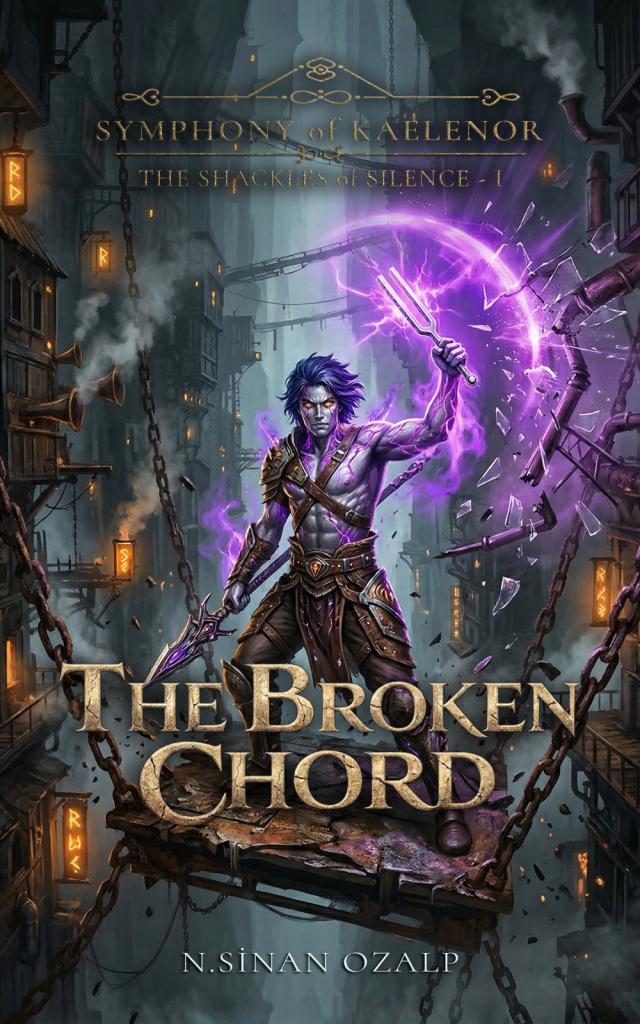


Koldar spoke without turning.
“Match your step to the ground, not to your voice.”
Korian clenched his teeth. Which voice? rose in him at once. There were still two of them in his throat. On the surface, a broken, exhausted young human voice. Beneath it, something metallic and foreign that showed its teeth whenever fear or anger touched it. But he said nothing. Koldar likely would not have cared.
At first the passage differed little from the other blind lines that fed into the workshop. Narrow, rusted, low-ceilinged, a vein where rock and metal had long ago learned to live together. But after a few bends, Korian felt the change. Not with his eyes at first. With his nerves.
Ironhold’s familiar brown-bass drone began to thin. Those heavy, muddy underwaves that tasted of rust seemed to filter through certain seams in the rock, where something finer mingled with them. The metal supports grew more sparse. The old transmission rings running through the stone looked nothing like the coarse workmanship of the maintenance tunnels; they were smaller, subtler, laid into the rock as though following the grain of the stone itself. That was when Korian began to understand why Koldar had chosen this place instead of the main lines.
This was not an official route.
It was a prepared escape line.
Koldar explained nothing. He did not need to. At every turn he passed through openings that at first glance would have looked like no more than fractures in the rock, struck loose points hidden within rusted panels with a single blow, or altered course by following three nearly invisible scratches on the wall. Long, short, long. Elias’s marks. Hidden, patient, small. As if they had been there for years. As if they had been left with the certainty that one day someone would need to find them.
When Koldar veered right, he gave the mark on the wall only a passing glance.
He did not ask, When did he start teaching you this? Even so, the shape of the unasked question hung in the air.
Korian did not answer. Because the honest answer would have been: Never. Elias had taught him how to hide, not how to run. Or at least that was what Korian had believed until now. But moving through these dark veins, among rusted signs and invisible seams, he could feel another preparation growing beneath his father’s silence, one that had been there all along. The feeling did not come as comfort. It felt more like losing Elias all over again. Because with every step, his father ceased to remain only the man Korian had known and became someone larger, more sealed, more strange.
Koldar did not slow.
At one point the ceiling dropped abruptly. Korian was too late to duck and struck his shoulder hard against a jut of stone. Air hissed through his teeth. Koldar did not even look back.
“You can count the pain later.”
“Then you count it,” Korian muttered. His voice was tired, but the thorns were still there.
This time Koldar turned his head halfway. The dull gleam of amber eyes in the dark held no warmth at all.
“I’ve got heavier things to count.”
The words hinted at some older root to all the hardness he carried, then closed again. Korian did not ask. Not because he did not want to, but because he had no strength for it. His grief was still too new. The thought of not abandoning Elias’s body to silent erasure had only just begun to harden into duty inside him. There was no room yet for Koldar’s past. Still, it was clear enough that the man’s severity came not from emptiness, but from some older fracture.
They descended one more slope. Then another bend. And then the voice of the tunnels changed.
The shift almost stopped Korian where he stood.
The rust-brown drones thinned. Into the muddy undertow were woven, first, fine silver lines, then the faintest whitish vibrations. They were nothing like Ironhold’s industrial sounds. They felt barer, more fragile, more glass-like—as though somewhere hidden in the stone ran thin veins of quartz or some transparent mineral, and when the Deep-Gutter’s heavy pulse struck them, it turned into something lighter, sharper, farther away.
Korian slowed without meaning to.
Koldar noticed at once. “Don’t stop.”
“The sound changed.”
“Yes.”
The answer was so flat that Korian felt, for a moment, almost angry at his own senses. As though something that seemed extraordinary only to him was, for Koldar, no more than the arrival of an expected threshold.
“What is this place?”
“More than Ironhold thinks it is.”
That answer opened not explanation, but another darkness. Koldar said nothing more. But the tunnel went on. And as Korian moved deeper into the altered acoustics, his synesthesia began arranging the world anew. The heavy brown bass no longer spread with equal thickness across every surface. On some stretches of stone it thinned and fractured like silver frost. In certain cracks it became milk-white, tremulous. In parts of the tunnel, sound behaved as though it were passing through glass rather than metal. Even the taste changed. Beneath the dominant bitterness of rust and oil there now came something colder, mineral, almost touching the enamel of his teeth.
This was another face of the city.
Perhaps another direction altogether.
Koldar quickened his pace. Not from panic—from calculation. He moved like someone who knew exactly how much time could be bought on which line, at what depth, through which throat of the rock. Korian was forced to keep up. Neither grief nor the body’s own rhythm suited that pace. But danger always had the stronger measure. More than once he nearly collided with Koldar’s shoulder or the flat black face of the Harmony-Breaker across his back. Each time Koldar left only a single word behind him.
“Left.”
“Duck.”
“Not there.”
There was no courtesy in the commands. But there was no waste in them either. Korian found them more grating and more indispensable with every turn.
At one point the way split in two. The line to the left still carried Ironhold’s brown, rust-thick, suffocating undertone. The narrow crack to the right was not quieter, only finer. Koldar entered it without hesitation. Korian followed. For the space of a heartbeat, the city’s weight seemed to fall behind them.
And there, for the first time, the foreign frequency appeared.
At first Korian did not even take it for sound. It felt more like a strand of glass drawn too thin and left trembling in the dark. There was grace in it, but not purity. It had the grace of something broken. It was thin, but not with a deadly thinness. Wounded. Alive. Within the vibration there was an organic hesitancy, like the shattered resistance of an instrument still trying to sing through pain. Nothing that belonged to Ironhold behaved like this. The city’s sounds were heavy, coarse, imperious, mechanical. This resembled the distant echo of some cracked glass instrument.
Korian stopped.
This time, truly stopped.
“There’s something here.”
For once Koldar did not rebuke him. He merely drew one shoulder back a little and listened. The slit in the Harmony-Breaker broke the undertone by the smallest degree. Then the amber eyes turned into the dark.
“What do you hear?”
Korian tilted his head slightly. He no longer even noticed himself doing it. Not to hear more clearly, but to trace the shape the sound left behind.
“Thin...” he said. Then the word failed. He narrowed his eyes. “But broken. As if...” He shook his head once. “Not like glass. Like a broken piece of glass that still remembers how to sing.”
Something small and intent tightened in Koldar’s face.
“Close?”
Korian drew breath. The foreign frequency answered by drawing back a little, as if aware of him—or at least alive enough to feel the weight of his attention.
“Not close,” he said. “But not fixed either. It’s moving. No...” He shook his head again. “Dragged, maybe. Like something wounded.”
The last word remained hanging between them.
Koldar did not move at once. For the first time, he stood like a man who took what Korian heard seriously. His clipped questions did not necessarily mean belief. But it was clear now that he did not take this sensory fracture for a curse and nothing more.
“It could be an enemy,” he said.
“Yes.”
“It could be a guide.”
This time Korian looked at him. “Why would you say that?”
Koldar shifted the Harmony-Breaker a fraction on his shoulder. “Because Elias wouldn’t send you into a blind line.”
The words opened another ache beneath Korian’s ribs. Elias’s name no longer came to him only with grief, but with direction as well. The fact was as consoling as it was cruel.
The foreign frequency stirred again.
This time Korian did not only hear it; he saw it as a thin milk-white fracture suspended before his eyes. Then pale, almost transparent rings, shaded with the faintest blue, widened around it. But they were nothing like the scanners’ icy hunting circles. These were more irregular, more fragile, more alive. It was as though something were trying to hide its own pain and, in doing so, involuntarily revealing itself to the dark.
The knot in Korian’s throat tightened for a moment. By reflex, he wanted to lift a hand to his neck. He stopped himself before Koldar could. That tiny hesitation was proof—small, almost absurdly small, but real—that the fragile third path he had glimpsed in the Deep-Gutter was still possible.
Whether Koldar noticed, he gave no sign.
“We keep moving,” he said. “But now you won’t look with your eyes first. You’ll look with your sound.”
Korian wanted to object. He did not trust his voice. He was still afraid of the thing inside him. But the foreign frequency stirred again out of the dark, and this time it gave him not only fear, but direction. It marked the line where Ironhold’s heavy, rust-thick drone ended and the finer, more glass-like veins began.
Not desert.
West-crystal.
Perhaps he did not shape those words consciously. But in the remade map of his body, the direction arrived like that.
Koldar gave the slightest nod for him to continue. The darkness before them grew finer, thinner. Behind them the city still hunted them with a heavy, brown, hungry pulse. Ahead, a broken but living note waited like a line that might prove threat or hope.
And Korian, feeling for the first time that the thing inside him could point as well as destroy, stepped once more into the dark.
Koldar’s hand shut against Korian’s chest like an iron door.
It happened so suddenly that Korian was thrown backward before he could take another step. His spine struck the damp stone of the narrow passage. The tuning fork clenched in his fist without his meaning it to. In the same motion, Koldar brought the Harmony-Breaker down from his shoulder and held it crosswise; the heavy weapon sealed the passage in a single sweep. His amber eyes were locked on that fine, glass-like vibration in the dark ahead.
“Back.”
Korian did not argue. He could not. Because what had seemed a moment ago only foreign and broken now came more clearly, more nearly. It was thin, yes. But it was not weak. It trembled like the last living string left on a shattered glass instrument, narrowing to almost nothing with each pulse, then holding on again by force of sheer resistance. Nothing in Ironhold sounded like this. The city’s sounds commanded, crushed, counted, marched, drove. This sound was in pain.
That did not matter to Koldar.
He lowered the tip of the Harmony-Breaker until it just touched the ground. Very lightly. Even so, the stone answered that touch with a blunt bass note from deep below. He tilted his head a fraction; the slit in the blade gave a faint hiss, as though testing the fine frequencies suspended in the air. Then he shifted one shoulder forward and moved fully into the line of the passage, placing his own body between Korian and whatever waited ahead. It was a defensive motion made by habit. It did not look like protection. It looked more like: I see it first. If you survive, then you may look.
The passage ahead narrowed, then opened abruptly. Here the rock behaved less like the familiar rusted organs of Ironhold and more like the remains of another origin. Veins of something translucent ran through the walls: broken quartz, perhaps, or frozen layers of glass, glimmering faintly white in the dark. The metal reinforcements were sparser here, older, less industrial in character. It was as though someone had marked this passage, used it, repaired it, long ago—but Ironhold’s official engineering had never fully claimed it.
Koldar took another step.
The foreign frequency answered at once. It did not retreat. It did not strike back, either. It only drew inward upon itself, becoming finer, more fragile, like light trapped inside a crack running through glass. Korian felt the change not with his ears, but in his teeth and under his tongue. Not cold. Dry, transparent, mineral. And then other things began to separate out within that tone: the iron smell of blood, the heavy breath of wet stone, the erratic sub-rhythm of an exhausted heart.
A victim, Korian thought. Not a trap.
But he did not say it at once. On an escape line, victim and trap could resemble one another far too easily.
Koldar spoke again, lower now, harder.
“Come out.”
The passage did not answer.
“If you can hear me, come out.”
Still nothing.
Only that glass-like frequency shifted slightly, as though it had leaned itself against one of the walls. Korian felt it distinctly. The weight of a body could bend the fine acoustic lines in the stone even without leaving a proper echo. There was someone there. Breathing. Hurting. Trying to hide. But not in the way an Ironhold body would hide. Even in concealment, the shape of the sound betrayed that it did not belong to this city.
Koldar lifted the blade a little more. “One step more and I let the wall answer for you.”
The threat was unmistakable. The heavy head of the Harmony-Breaker hung close enough to the quartz-veined rock for Korian to know that if Koldar brought it down, he might not only destroy a body but shatter the entire fragile line of the passage. The foreign frequency seemed to understand that as well. Because in the next moment, a human-shaped shadow stirred very slowly in the dark.
First came only the sound of cloth shifting. No—not sound exactly. A thin milk-white line opening in the air. Then a hand separated itself from the black face of the rock. Long, slender fingers. At the joints, the faint glitter of glass dust. Then the arm that followed it. Pale skin. Lean muscle, not even attempting to disguise its weakness. At last the rest of the body: half-sitting, half-collapsed against the wall.
Korian knew she was a woman not from her face at first, but from proportion. She wore no armor. Nor did she wear the thick cloth, lead-lining, and insulating layers of Ironhold laborers. Though the journey had torn her outer garments badly, beneath the ragged dark cloak there remained a finer underlayer—something fluid, layered, belonging to Luvia or to the crystal cultures west of that line. Along the edges of the cloth, small translucent fragments still clung like remnants of broken glasswork. They were not decoration. They were pieces of craft made to carry frequency, perhaps to direct it, perhaps once to hold song within it.
Her eyes were open.
But Korian knew at once that they were not seeing.
The irises had gone pale grey, drained of light; and yet they did not carry the dead vacancy of true blindness. She had turned her head not toward Koldar’s voice, but toward the way his voice disturbed the stone. The muscles in her neck made minute adjustments. The fine nerves about her ears seemed to tremble as though plucked by invisible threads. She was reading the world not with sight, but with the splintered acoustics returning to her from it.
Her left leg was blood-soaked below the knee. The dark fabric there had stiffened down the thigh. Beside her right hand lay a broken transparent staff—or perhaps a walking rod—made not of glass, but of some material that sang like glass. The little ring at its end had cracked, and from that fracture there leaked a faint keening note. The moment Korian heard it, his skin prickled. Because it was not the source of the foreign frequency. It only accompanied it. The true tone came from inside the woman’s body itself. Something whose inner tuning had gone wrong, yet still refused to come apart.
Koldar did not lower the blade.
“Who are you?”
She did not answer at once. Her lips parted. She drew breath. Even that breath was not clean. It did not come double-layered the way Korian’s own did; it emerged instead split and brittle, as though passing through a narrow crystal tube. Then she turned her head not fully toward Koldar, but toward where Korian stood.
In that instant, Korian understood: she could not see him, and yet he was not hidden from her.
Her brows tightened slightly. It was not the expression of someone trying to focus on a shape in the dark, but of someone trying to resolve a wrong chord in the air. Her lips moved again.
“...No,” she said. Her voice was dry, scarcely louder than a whisper. “Not from this city.”
Koldar did not soften. “Your name.”
Again she did not answer. Her right hand moved toward the broken staff beside her. The motion failed halfway. Koldar raised the Harmony-Breaker by the breadth of a finger. She froze. Her hand hovered in the air for one brief second, as though it might fall into emptiness.
Korian could see now that she was not only wounded. Balance itself had gone out of her body. It was as if someone had torn the inner strings of her apart and still demanded that she remain upright. Her heartbeat was irregular; he could feel it in her sound. Her breathing kept breaking in the wrong places. Even the blood moving through her carried tiny dissonances, like a hundred fine cracks traveling inside glass.
“I won’t kill you,” Koldar said. “Not yet. Speak.”
At that, the woman let out the faintest sound that might almost have passed for laughter. It was no true laugh. Only a dry, exhausted fracture of breath, edged with something like irony but more deeply yielded to pain.






