

Rune to ruin, p.1
Rune to Ruin, page 1
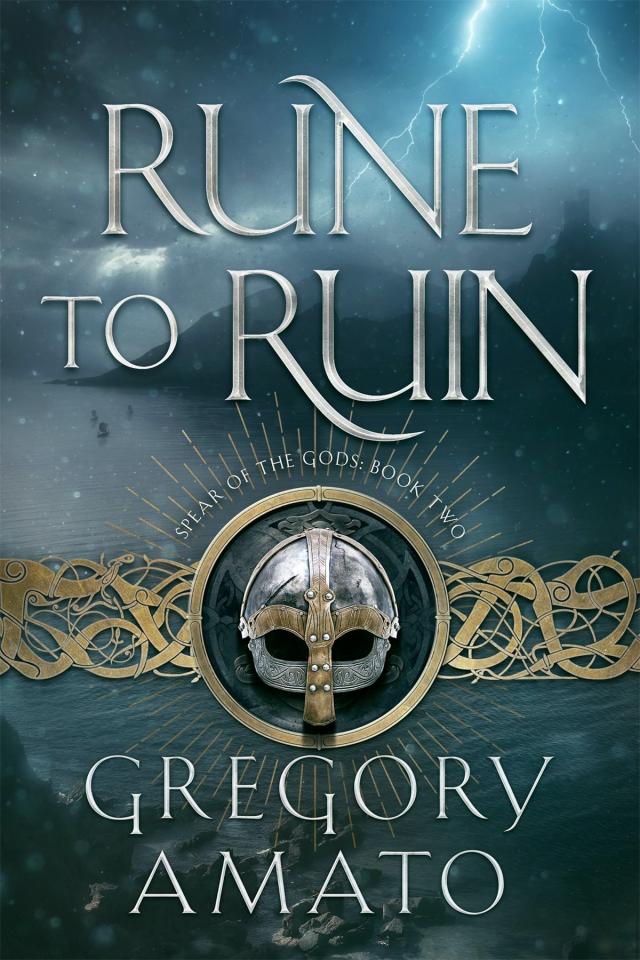


Rune to Ruin
Spear of the Gods
Book Two
Gregory Amato
Published by Sed Ferro Press
Copyright © 2024
* * *
All rights reserved. No part of this publication may be reproduced, distributed, or transmitted in any form or by any means, including photocopying, recording, or other electronic or mechanical methods, or by any information storage and retrieval system without the prior written permission of the publisher, except in the case of very brief quotations embodied in critical reviews and certain other noncommercial uses permitted by copyright law.
Cover design by James T. Egan of Bookfly Design
Illustration by Blane Bellerud
Edited by Sydney Taylor
* * *
Paperback ISBN: 979-8988061328
Hardcover ISBN: 979-8988061335
* * *
Published by Sed Ferro Press
3439 NE Sandy Blvd, #484
Portland, OR 97232
This series is for Emlyn Amato. You didn’t read this story, mom, but you were first and foremost in believing.
Contents
Author’s Note
Runes - The Elder Futhark (Pre-Viking Age Alphabet)
The Story From Book One
1. On Rising at Night
2. The Dwarf’s Errand
3. The Fylgja
4. Plans Without Plans
5. Rune
6. Scene of the Crime
7. The Stone Road
8. Down-Below
9. The Road to Myrkheim Is Not Paved
10. Dense Negotiations
11. Any Witch Way She Says
12. Sputum Democracy
13. Rewriting the Present
14. Getting a Head
15. A Wise Man’s Heart Is Seldom Glad
16. Sun and Steel
17. A Song of Spring
18. Herding Cats
19. The Virtue of Revenge
20. Gifts and Repayment
21. The Dead Man’s Pants
22. Mostly Harmless
23. Pawn Protection
24. That Roman Magic
25. Saxa Ex Machina
26. Blood Eagles Are Overrated
27. Harping On
28. The Queen in the Rock
29. The Courage to Look
30. No Fish Is an Island
31. A Short History of the End of the World
32. The Eternal Skald
33. Water Hazard
34. A Wise Man’s Heart Seldom Glad, Again
35. The White Sea
36. Arrow-Odd’s War
37. The Trouble With Peace and Quiet
38. A Troublesome Poet
39. Haldor’s Story
40. The Solution to Idle Hands
41. Freely Offered
42. The Bridge to Hel
43. Ruin
44. The Man Who Would Be Prey
45. Upward Spiral
46. Brisingamen
47. The Wolf Inside the Door
48. Last Laugh
49. Heroes
50. Limited Hospitality
51. The White Sea, Stained Red
52. Not Again
53. The Raven-Haired Valkyrie
If you enjoyed this story
Coming Next in Spear of the Gods, Book Three: Fallen to Fury
Also by Gregory Amato
About the Author
Acknowledgments
Major Characters
Glossary of Old Norse Words
Author’s Note
Though Norse myths still predominate in Rune to Ruin, there are some Finnish myths involved in the story, too. Much as I’ve always loved the Norse myths, the stories that survive today don’t include much adventuring by their chief skald, Bragi. It’s the Finnish myths that have the more adventurous skald, even if they call Vainamoinen a bard instead.
The primary work of Finnish mythology I refer to is the Kalevala, or Land of Heroes. And sometimes, it is the work I take the most inspiration from as a writer. Why? Because Kalevala elevates the bard to the champion of mortals, the foremost hero, even the most powerful wizard.
Vainamoinen is not just the eternal bard of Kalevala. He’s also its biggest badass. In today’s world, where the idea of a bard is largely based on a weak Dungeons and Dragons character class, that might seem counterintuitive. It shouldn’t be.
Recurring themes in the Spear of the Gods Saga include poetry and drengskapr, the Viking Age notion of being a bold person, or badass (drengr). In 2024, I think the notion of principled storyteller as hero is more important than ever. Today, the power of communication technology seems largely used to fight against unpleasant truths rather than to spread knowledge. It’s easier to play to what an audience wants than to adhere to the true spirit of a thing that might be uncomfortable. And it gets more clicks, more views, more insipid updoots—all held up as measures of value, even if the message has none.
I think the skalds would shake their heads at that. Knowledge is more often painful than reassuring in the Norse myths. Just ask Odin about hanging on that tree. Real learning isn’t easy or casual, or meant to validate beliefs already decided on.
I like Vainamoinen so much in part because he doesn’t just tell stories about what he knows; he’s willing to throw down over the truth of a thing. He doesn’t preach about his ideals, he just lives them in the clearest possible ways, and that is part of his heroism. What is a person called who wanders, speaking the truth, telling stories, spreading wisdom, offering patience for the unknowing but wrath for those who spread denial and lies?
A bard. A skald. A drengr.
* * *
-Gregory Amato, 29 July 2024
Runes - The Elder Futhark (Pre-Viking Age Alphabet)
Rune Name Ideographic Meaning
ᚠ fehu wealth; cattle
ᚢ uruz aurochs; strength
ᚦ þurisaz þurs, jǫtunn
ᚨ ansuz god
ᚱ raiðo ride, journey
ᚲ kaunan ulcer, blister, boil
ᚷ gebo gift
ᚹ wunjo joy
ᚺ hagalaz hail
ᚾ nauðiz need
ᛁ isaz ice
ᛃ jera harvest; good year
ᛈ perðo pear tree or game piece
ᛇ eihaz yew tree
ᛉ algiz moose or elk
ᛊ sowilo sun
ᛏ tiwaz the god Tyr
ᛒ berkana birch tree
ᛖ ehwaz horse
ᛗ mannaz human
ᛚ laguz water
ᛜ ingwaz the god Frey
ᛞ dagaz day
ᛟ oþala inheritance
The Story From Book One
Ansgar Styrgrimsson is a traveling poet and storyteller in the North—a skald.
Until about a year ago, his job was to deliver weapons for his foster-father. He knew how to pick his paths, how to run, ski, and climb faster and longer than others, and how to trade information with ravens and tell stories at mead halls to his benefit.
It was a simple job until one delivery went bad. Then Ansgar found himself needing more protection than expected, wishing he had more approval from his father than expected, and drinking more mead than he expected.
Blame it on the mead or not: He swore to join the crew of the Sea Squirrel that night.
The good news was he had found some excellent new friends in Haldor Skullsplitter and company. The bad news was they were a crew of monster hunters he had no business trying to prove himself with. Further bad news: Their last five skalds had all died horrible deaths soon after joining.
In the first few weeks of joining, Ansgar found out what seasickness was. Being pummeled, drugged, and even chased by the Midgard Serpent did not add to his confidence, and he felt like a burden to the crew.
But he also chanted for a powerful sorceress, traveled to Asgard to speak to the gods, and helped free a dwarf from bondage. That’s enough to make a person bold.
He would need that boldness and a lot more as the crew traveled to aid the king of the Danes. Haldor’s intent was to solve the king’s troll problem right away, but the Danish court was a complicated place. Queen Alfhild was not so warm to the crew’s presence. Also, she was a witch.
With the troll suspiciously hard to find, Ansgar did some wandering and made both friends and enemies. First among friends was the drunken wizard living in the forest nearby, who agreed to teach him the magic of the runes. Also a friend was the witch, Fanya, one of Alfhild’s handmaidens. Maybe she could be more than a friend, he hoped.
Alfhild’s mercenaries in the city: Definitely enemies. As for Alfhild herself, it was difficult to tell what she was up to. Especially after she tried to seduce Ansgar.
He never did figure that part out.
He did figure out the troll’s location, though. Right in front of him, he realized, at a time he had no pants on. The troll gave chase, the skald was captured by Alfhild, and then things started to get weird.
Fanya, at least, helped him escape. Meanwhile Alfhild had the entire city of Lejre under attack. Trapped in a burning hall with his friends, Ansgar attempted what rune magic he knew to get them out. And failed.
Failed, but found himself turning into a giant polar bear. The Battle for Lejre was on, and it would take that giant bear, the turncoat witch, and the late appearance of a drunken wizard to stand against Alfhild’s magic.
The dead rose to fight again, even Alfhild’s dragon. Haldor’s Heroes hacked them back down, but n ot without losing good friends in the process.
Ansgar barely survived. “Favored by Odin” they began to call him, and he earned his armring as one of Haldor’s sworn men.
That’s a lot of praise for one man, even if he still doubts himself now.
One thing he does not doubt: They will pursue Alfhild wherever she has fled to, and whatever the cost . . .
Chapter 1
On Rising at Night
One night that winter in the Danish hills, I thought a witch had cast a spell to freeze my balls off. She hadn’t. But in my defense, it was a reasonable belief at the time. I was feeling ill in body and mind before that happened, though, and those ill feelings are where I’ll begin:
I sat bolt upright in the longhouse, sweat streaming down my face, thankful for the sounds of howling winds of the ice storm outside to mask my heavy breathing. The hearth fires crackled low, which made the place less smoky than usual but considerably less warm than my skinny bones preferred.
It was a sturdy hall, the kind that made you feel secure even when you were one wall away from icy death outside. Secure as those walls were, they were no defense against my own imagination.
Nightmares had come three times in a row. Had I cried out in my sleep this time? I hoped not and looked around to see if I’d woken anyone.
My crew slept undisturbed all around the longhouse on benches, under tables—wherever they could find space. They were more than a crew. Most of them were my Brothers now, all sworn to the same oaths and wearing the same armrings.
Haldor Skullsplitter lay resting against a wall, our leader on land leaving the rest of us space nearer to the hearth. His massive chest moved with each breath beneath a heavy wool blanket. His great axe, named Silence, lay propped against the wall beside him.
Kraki Bentleg, our leader at sea (good) and cook (terrible), never seemed to need a blanket. Or a shirt, for that matter. He sat in a corner, arms crossed, pale skin bright even in the low light of the hall. I did not worry about the old man. That sagging, pasty skin might not look like much, but I’d seen it shrug off blades and turn spears with little more than superficial wounds.
Svein, as big or bigger than Haldor, did not share the habit of sleeping in silence. He lay near the hearth fire, swaddled in wool, and snored like a boar in heat.
I hoped the noises from him and the wind had been enough to mask any sounds I might have made. And I thought it likely I’d made some unhappy sounds while asleep because I felt quite unwell. Indigestion accompanied the nightmares this time. I held one hand to my growling stomach. Sounds muttered back, not in my language yet unmistakable in their meaning.
I thought I heard a voice in my head whispering go outside. Soft, uncritical—a remnant of sleep, yet not of the nightmare, or else I might have been more hesitant to take the advice.
The land of the Danes was not some frozen Hel-scape. The winters here were usually mild compared to my mountainous home in the North-Way. The land of the Danes was mostly flat but for the hill the king’s longhouse stood upon. This winter had been uncharacteristically harsh, though. Had I stayed inside that longhouse, my balls would have remained in a fully thawed state, if a bit chilly. But this night, the winds in my intestines competed with those outside for sheer ferocity.
The dead of such a winter gives a person two choices about where to take a shit: Inside, where it is cold, or outside, where it is teeth-shatteringly cold. I had some status that winter, having saved our crew during a heroic, if accidental, shape change. That shape was a giant polar bear—it was pure luck it hadn’t been a marmot or a weasel or something else.
That change gave me the chance to charge through a flaming oak wall and save our crew, the sort of act that leaves an impression. That impression solidified when I tore half the enemy army’s champions apart, eviscerated their giant boar demon, and broke their dragon’s neck. I nearly killed our enemy, Queen Alfhild, too, but she’d disappeared at the last moment.
This was a better reputation to have than my previous one. As the ship’s skald, I had been known for coming up with a good line of poetry or two, sure. When I wasn’t vomiting over the side of our ship.
But I didn’t have so much status that I had someone designated to deliver my defecations to the outdoors for me. And certainly not during this hour. Only rise at night if you intend to spy on your enemies or relieve yourself, went the wisdom of the time.
So I fastened my snow shoes and went outside to not spy on my enemies.
The ice storm I walked into gave me pause. I made my way not too far from the hall. Any farther, and the longhouse would have become invisible in the weather. Even holding the rope we used to ensured we could find our way back, I didn’t want to stretch my luck. Keeping hold of a rope tethered to the longhouse while outside was one rule, as was not going beyond the rope to do your business.
I wasn’t even at the end of the rope when I considered a hasty retreat, but that would mean yet another night of no sleep as my intestines played a long, slow song of lament until morning. I’d had enough of that and hoped some physical relief would give my mind a break. Those nightmares had been bothering me for weeks. Some nights were fine. Others, like the last few, showed me images I did not wish to relive.
Nightmares about seeing Fanya, the love of my life, holding her guts in with one hand while she held her spear high to cast a last spell. Nightmares of bringing a rock down on the head of a troll who called me “cousin” in his last moment. Whispers attacked me in my dreams. “Ansgar Kinslayer,” they called me. The worst of the fear had subsided, but it still left me shaking.
I thought I heard the go outside voice again, but it was too soft for me to be sure. I was already outside, and I’d already concluded the voice was my own sleepy thoughts talking me through the thing I clearly needed to do: Go outside, do my business, come back inside, and hope for no more nightmares. That was my plan, a simple one under ordinary circumstances.
I held the rope tight as I squinted into the white darkness. The snow provided illumination, and at the same time, it shrouded everything behind it. How far I went out, I don’t know—just far enough for good manners. It’s important to angle your snowshoes out behind you at a time like that meanwhile hiking up some clothing and down other clothing. I like to think that winter improved my overall coordination. It also provided me a lesson in what being cold really was, a lesson that would serve me well later.
The wind picked up, and sky-shards pelted my privates. I soldiered on. In a moment of delicate balance, I held my cloak from billowing out around me and tried to perch in a position conducive to relief.
Fully relieved, I sidestepped and grabbed a handful of snow to clean myself. Relaxed and thinking I had finished the most difficult part, there was a sudden sensation like an icy hand rising through the snow and tugging on my sack.
Cold and fear shot through my body from the source up to my brain and leaked out of my ears. And I reached what seemed the only reasonable conclusion: Alfhild had reached through the ice storm with her magic, grabbed my balls, and literally frozen them off.






