Mystery magnet, p.1
Mystery Magnet, page 1
part #1 of The Last Picks Series


This is a work of fiction. Names, characters, places, and incidents either are the product of the author’s imagination or are used fictitiously, and any resemblance to actual persons, living or dead, business establishments, events, or locales is entirely coincidental.
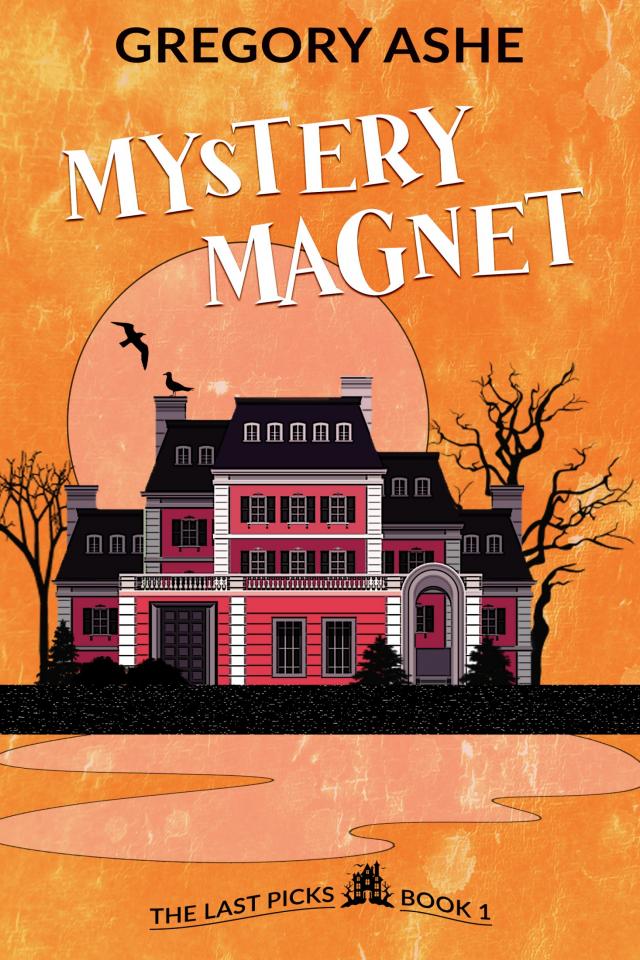
Mystery Magnet
Copyright © 2024 Gregory Ashe
All rights reserved. No part of this book may be reproduced in any form, stored in any retrieval system, or transmitted in any form by any means—electronic, mechanical, photocopy, recording, or otherwise—without prior written permission of the publisher, except as provided by United States of America copyright law. For permission requests and all other inquiries, contact: contact@hodgkinandblount.com
Published by Hodgkin & Blount
https://www.hodgkinandblount.com/
contact@hodgkinandblount.com
Published 2024
Printed in the United States of America
Version 1.05
Trade Paperback ISBN: 978-1-63621-080-3
eBook ISBN: 978-1-63621-079-7
Chapter 1
“Do you like puzzles?”
I resettled my glasses and managed, “Um, yes?”
Okay, maybe not the strongest answer in what was technically a job interview. But cut me some slack; I had a lot going against me. In the first place, I was talking to Vivienne Carver. The Vivienne Carver. In the second place, I was operating on zero sleep because my cross-country drive had taken longer than I expected. I’d covered the last hundred miles that morning in a bleary-eyed sprint to reach this little town on the Oregon Coast. And third, in spite of everything that had happened, I was still (apparently) the same old Dash.
Which was why the next words out of my mouth were “Actually, yes. I mean, definitely.” The words were like a freight train; I couldn’t stop them as I blurted, “In fact, I love puzzles.”
Vivienne’s eyebrows went up. She looked like she does on TV, in case you’re wondering. And in the author photo on her dust jackets. She was blond, like a lot of women of a certain age, her hair a medium length and layered and curled and styled until it was the size of a basketball. A red sweater—classic Vivienne. A pair of cheaters hung on a chain around her neck, but it was hard to imagine she needed them, because her eyes were a startlingly intense blue. She had great skin. Wrinkles, sure, but she could have passed for twenty years younger.
All right, ten.
“I think puzzles are the heart of a mystery novel,” she said. “Don’t you?”
“Well,” I said, “yes.”
Vivienne opened her mouth.
I tried to stop myself, I really did. But it was another blurt: “And no.”
Vivienne closed her mouth.
“But mostly yes,” I said. “I mean, yes. Absolutely. The heart of a mystery novel.”
She opened her mouth again.
Sometimes, being Dashiell Dawson Dane was like being in a horror movie: you knew you weren’t supposed to go down into the basement alone to check the circuit breaker, or you knew you weren’t supposed to get freaky with the rude but cute jock in the backseat of his car at Make-out Point, or (just for the sake of example) you knew you weren’t supposed to keep talking. But you just. couldn’t. help yourself.
“It’s just—the puzzle,” I said, “and the human element.”
Vivienne closed her mouth again. Her eyes really were stunning. That was, apparently, the kind of thing I could think while I was having an out-of-body experience.
But then she smiled and said, “Quite right, Dashiell. That’s well put. The puzzle and the human element. Very well put. Not that I would expect any less from you. I read ‘Murder on the Emerald Express.’ It was very clever. Quite the send-up of Christie, I think.”
“Thank you.”
“And your parents, of course.”
And there it was. The whole reason I was here. Not because I’d written a couple of short stories that had eventually landed in Black Mask and Flying Aces. But because I was the son of Patricia Lockley (Mommy’s Sleeping and Blind Furies and What the Laundress Saw) and Jonny Dane (the Talon Maverick series). Because, to put it bluntly, Vivienne was doing her colleagues a favor.
Not that I cared. At least, not too much. I needed to get away from Providence (and Hugo), and here I was—about as far as you could get.
“How are your parents?” Vivienne asked. “I haven’t seen them in ages.”
“They’re all right.”
“And what are they doing these days?”
“Oh, you know. Mom stays busy with the chickens, and Dad has his guns.”
Vivienne laughed, and I tried to smile, fighting the familiar tightness in my chest.
“Portsmouth really is so charming,” Vivienne murmured. “I’ve only been once, and your parents were such wonderful hosts. I’d love to see them again.”
“I’m sure they’d be happy to have you visit.” I dredged up another smile. “I hope you like skeet shooting.”
That made her laugh again. She settled back into her chair—it was so massive that it was really more of a throne—and examined me more carefully. After a moment of that long, considering stare, I looked away. Her study, where we were having this interview, was exactly what a famous author’s study should look like: a cavernous fireplace, built-in bookcases (filled with her own titles, of course—all the books in the Matron of Murder series, and translations into dozens of languages), a massive cherrywood desk. She had a laptop, a sleek little aluminum thing, but the typewriter that featured so prominently in the Matron of Murder TV adaptation still had pride of place. Posters from the show lined the walls. The actor they’d picked looked remarkably like Vivienne, even though the protagonist in the books, Genevieve Webster, was nominally fictional; I wondered if she’d had any say in the casting. Interspersed with the posters were photos of Vivienne. Vivienne with politicians. Vivienne with celebrities. Vivienne accepting honorary degrees and keys to various cities. Pictures of Vivienne when she’d been younger—glamorous, but not quite beautiful. Apparently, she owned (or had owned) a yacht.
“Tell me, Dashiell—”
“Just Dash.” I rushed to add, “Unless you prefer Dashiell, that is.”
She was silent for a beat. “Tell me about your writing, Dashiell.”
“Well,” I said. And that was as far as I got. That tightness in my chest worsened. “I’m very passionate—”
“Your ideas, Dashiell.” She waved a hand. “Your plans. Yes, I understand that your position here will be as my administrative assistant. But we both know it’s a bit more than that. You’re a talented writer.” She gestured to the desk, even though it was bare aside from the laptop and typewriter. “Your resume is impressive. You’ve attended top writing workshops. You’ve done some teaching yourself.”
“Just as an adjunct.”
“And you have publications.”
“Two short stories.”
“But good, Dashiell.” She leaned forward. Her glasses swung on their chain. Her gaze seemed to spear me to my chair. “They’re good stories. They’re smart. Even better, they’re true. I don’t need to ask you about your references. I don’t need to know that you can type and use a word processor and answer phone calls. I want to know who you are, and I think you know, Dashiell, that the way to know a writer, truly know them, is to know their stories. People lie all the time. But every story is an act of disclosure, no matter how hard we try otherwise.” She waited, as though I might say something, and then sat back again. “So, let’s hear them.”
“Well,” I said. I almost mentioned Will Gower. Vivienne genuinely seemed to want to know, and I’d lived with Will Gower in my head for so long, in all his various incarnations. But Phil, Mom and Dad’s agent, had said no more Will Gower. He’d said I needed something high concept. Something with a hook. “I guess one of them is—have you seen 21 Jump Street?” The silence grew until I said, “Like that. Only gayer.”
Vivienne blinked. “That sounds…timely.”
The words loosened something in my chest, and I sat forward, talking more easily now. “Oh, and do you know Veronica Mars? That’s another idea. But make it, like, super gay.”
“I see.”
Excitement made me speak faster. “Or Riverdale. And I know what you’re going to say, but yes, we can go gayer.”
“Uh huh.” For a moment, her face was blank. And then she gave a rueful grin. “Are you going to be terribly disappointed if I tell you I have no idea what you’re talking about?”
Then she started to laugh, and for some reason, I found myself laughing too.
“I’m sorry,” I said. “I can explain—”
“You’ll explain later,” she said, waving the words away. “I want to hear all about these ideas. I’m very impressed with what you’ve done, Dashiell. Very impressed. And I want to see more of it. You’re very talented, and you’re going to go on to do great things.” She gave me a droll little smile. “And if I can offer a spot of advice here and there, well, I’d be happy to help however I can.”
“Oh my God, that would be incredible. I—I’ve been struggling lately. With writing. Struggling to finish things. Struggling, um, to write anything, actually.”
It was impossible to read her expression, but her voice was kind when she finally said, “I know a little something about that myself, believe it or not. We’ll see if we can’t shake something loose.”
“That would be amazing.”
“It would be friendly, Dashiell. This is a small town; being friendly is our way of life.”
“I don’t want you to think I expect you to, I don’t know, do anything. You’re busy, I understand that. And this is a job. I’m not asking for special treatment or favors or anything.”
“I understand,” she said gently. “And I’m telling you that I want to help you. I’m looking forward to it, actually. Life does get a little stale every once in a while. I believe you’re going to be a breath of fresh air.” Her pause had an unexpected quality to it—something I thought might be another kindness. “Your mother was distressed when she called me. I understand you made the decision to move rather suddenly.”
“It might have seemed sudden to other people,” I said. I fought to keep my voice easy and relaxed. “But I’d needed a change for a long time.”
“I understand you’ve had some…difficulties lately.”
Shaking my head, I said, “I’m fine. My parents are being dramatic.”
Vivienne said nothing, but the raw intelligence of those blue eyes told me she didn’t buy it. I waited for the thing I couldn’t handle: questions about Hugo. Questions about why. The questions my parents had been asking for weeks.
I spoke first. “I promise, Mrs. Carver: I’m fine. The chance to work with you is an incredible opportunity. I’m excited to be here, and I promise, I’m not—” I almost said, I’m not running away from anything, but that would have been a lie. “—going to let you down.”
In the distance, the surf crashed restlessly.
Then Vivienne nodded. “So, you’ll take the job?”
A beat passed as I processed the words. “Yes, definitely, absolutely.”
“Wonderful. We’ll have some paperwork for you to sign later, of course. Non-disclosure agreements, tax forms, that kind of thing. Writing is a craft and an art, I don’t need to tell you that, but it’s also a business—most people are terribly disappointed when they learn that, but I’m sure it’s something you learned growing up with your parents.”
“I don’t know if they’ve ever learned it,” I said. The surge of relief at her offer—a job, a place to live, stability—was so great that the words slipped out before I could stop them. My face heated as I added, “They let their agent handle everything. And their accountant, I suppose.”
“Then I see we have some work to do,” Vivienne said as she came around the desk and took my arm. “If there’s one thing I can teach you, it’s business. Now, let me give you a quick tour, and we’ll get you settled. I bet you want to rest after your early start this morning.”
“How did you—” I cut myself off and grinned. This was, after all, Vivienne Carver. “Okay, how did you know?”
“A hint of stubble; you don’t have a heavy beard, but it’s there. And you missed a button on your shirt.”
I fumbled at my placket.
“And you did seem a bit flustered as you came up the drive, dear.”
Groaning, I shook my head. A bit flustered was putting it mildly.
Vivienne patted my arm and laughed gently. “It’s all right. We’ll get you squared away in no time.”
She hadn’t been joking when she’d called it a quick tour. Hemlock House—Vivienne’s cliffside manor (there really wasn’t any other word for it)—was enormous, and it was old, too. Fireplaces in every room, damask wallpaper in deep hues of red and green and blue, wainscotting, polished wood floors covered by thick rugs. And God, so many crystal chandeliers. Heavy drapes framed the windows, and as we walked, I caught glimpses of the sea cliffs and, below them, the slate-green waters of the Pacific. The briny smell of the ocean was familiar and not at the same time. I’d grown up in a seaside town, but in a very different part of the world.
“Hemlock House was built by Nathaniel Blackwood,” Vivienne said as we walked, her arm in mine. “He made a fortune in the late nineteenth century, fur and timber and agriculture, and—this will be your room, dear—” She opened a door, and I caught a glimpse of an enormous canopy bed, a secretary desk, an oil painting of a horse, and what looked like a very expensive clock. Then we moved on. “—and he retired here with his much, much younger bride.”
“Some things never change,” I said.
Vivienne laughed. “No, they don’t. And I’m sure it won’t surprise you to learn that Nathaniel Blackwood was, to put it mildly, an eccentric.”
“The Howard Hughes of beaver pelts.”
“Something like that. He spent years working on the plans for Hemlock House. Years, dear. And he was unbelievably exacting in the construction. Spent an absolute fortune building it, making sure everything was exactly as he’d dreamed, and then died shortly after it was finished. He fell from the balcony and died on the cliffs. His bride, as you might imagine, went on to live a long, happy life with a parade of lovers.”
“He fell,” I said. “Right.”
Vivienne gave me that droll little smile again, but it faded as she said, “She died the same way, strangely enough. A fall from the balcony.”
“So, no going out on the balconies. Check.”
“She was pushed by a younger man. He claimed he didn’t do it, of course, but everyone knew—there’d been fights about money, fights about other women. The bride never had any children, and the estate was a legal morass for decades. Finally, the house was sold to a private investor who went to great lengths to preserve the historic aspects. Most of the furniture is original, although there have been updates for modern conveniences.” In a guilty whisper, she added, “I couldn’t live without cable.”
“I couldn’t live without coffee.”
A grand central staircase led down to the main floor, and when I say grand, I mean grand. Think, Disney castle grand: a sweeping spiral of polished marble, with a crystal chandelier hanging in the open well at the center. I’d come this way when I’d arrived, of course, but I’d been so nervous about the interview—if that conversation, in hindsight, could even be called an interview—that the details had registered only peripherally. Now I took it all in: the oil paintings in gilded frames (more horses), the black-and-white checkerboard tile (more marble), the unmistakable spaciousness of it all, as though the house had been built for giants. And, I noticed, the person lying on the floor, splayed out like a body at a crime scene.
“Uh—”
“That’s Fox,” Vivienne said. “Fox, this is Dashiell.”
“Just Dash,” I said apologetically.
Vivienne studied Fox for a moment and said, “They’re doing something with the wallpaper. I have to admit I don’t really understand it. How’s it going Fox?”
Fox was stocky, their dark hair buzzed and sprinkled with silver; I put them somewhere in their forties. In their ankle boots and paisley vest, they looked like they were striking a balance between hipster and steampunk. Without raising their head, they said, “Terrible. It’s a disaster, and everything’s the worst, and I’m dead.”
“They’re very dramatic,” Vivienne confided.
“I’m not being dramatic. This project was a huge mistake. I’ll never be able to do it. I’m a fraud and a sham. My life is over.”
“They’re an artist,” Vivienne said, and then, a bit more loudly, “And an artiste.”
Fox moaned.
“Something with sea-glass,” Vivienne said as we continued down the stairs. For a lady in her sixties, she was spry—I’d read an interview she’d done in Ellery Queen, and she’d talked about running and bicycling and, I kid you not, her beloved mini trampoline. “Fox is very successful.”
“Not anymore,” Fox said from the floor. “I’m a huckster. I’m done.”
“Dashiell is going to be joining us at Hemlock House, Fox. Do you have any words of wisdom for him as he settles in at Hastings Rock?”
“Never love or cherish or hope for anything,” Fox said in a broken voice. “Life is a trap.”
“And they’re ever so much fun at parties,” Vivienne murmured as she led me across the hall. We passed through a pair of pocket doors into the living room. It had the biggest fireplace I’d seen yet, with a pristine marble surround, a tarnished overmantel mirror, and a decorative tile-work hearth. Shiny brass fireplace tools and a matching screen. Maybe it sounds like I’m spending too much time on this fireplace, but it was enormous. You could have driven a hearse through it.
Like the rest of the house, this room had those lovely details and decorative elements that marked it as a product of another time (and another socioeconomic class). Cornicing, ceiling roses, more of those dramatic crystal chandeliers. Tufted sofas in brocade and velvet flanked by wingback chairs of aged leather. Mahogany tables cluttered with brass and glass curios (a telescope, a miniature globe, a bowl). Tall windows, their curtains held open with tasseled tiebacks to let in more of the day’s cloudy light. And, of course, bookcases. These weren’t Vivienne’s books. These looked like they’d come with the house, with beautiful bindings that had weathered the perpetual seaside damp surprisingly well. Interspersed with the books were botanical prints and porcelain figurines and glass cloches that held taxidermy birds.