Bitter flowers, p.1
Bitter Flowers, page 1
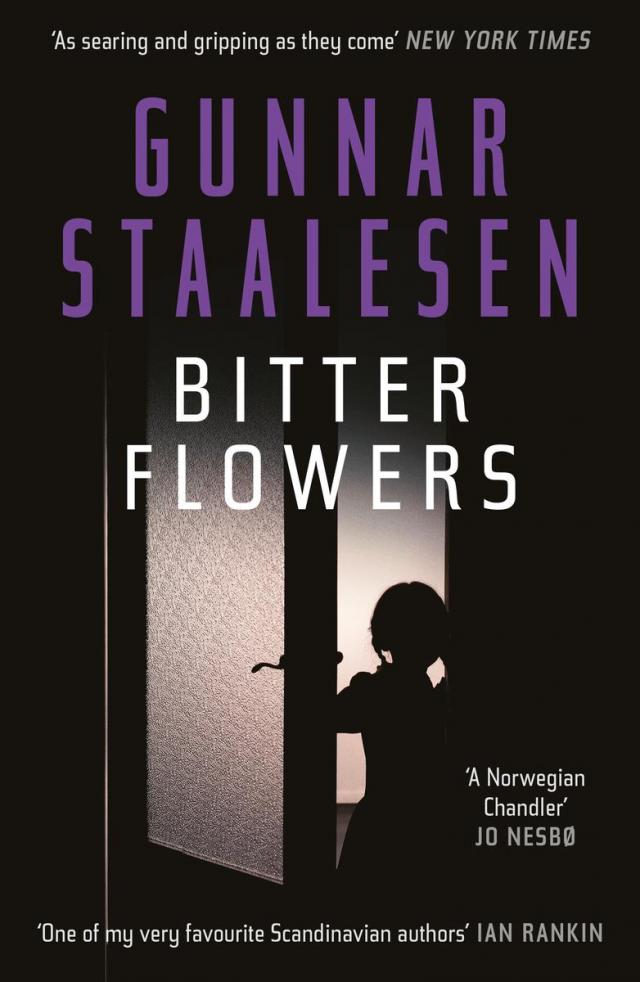


PI Varg Veum has returned to duty following a stint in rehab, but his new composure and resolution are soon threatened when he’s thrown into a complex, three-pronged case.
A man is found dead in an elite swimming pool and a young woman has gone missing. Most chillingly, Varg Veum is asked to investigate the ‘Camilla Case’: an eight-year-old cold case involving the disappearance of a little girl, who was never found.
As these three apparently unrelated threads come together, against the backdrop of a series of shocking environmental crimes, Varg Veum faces the most challenging, traumatic investigation of his career.
Bitter Flowers
GUNNAR STAALESEN
Translated by Don Bartlett
Bergen, Norway
AUTHOR’S NOTE
As there is actually a company in Hilleren, it would be appropriate to point out that the one described in this book, like all the characters, is purely the product of the author’s imagination, with no connection to reality.
—GS.
He who laughs last is the last to laugh.
—Erling T. Gjelsvik
CONTENTS
TITLE PAGE
AUTHOR’S NOTE
EPIGRAPH
1
2
3
4
5
6
7
8
9
10
11
12
13
14
15
16
17
18
19
20
21
22
23
24
25
26
27
28
29
30
31
32
33
34
35
36
37
38
39
40
41
42
43
44
45
46
47
48
49
50
51
52
53
ABOUT THE AUTHOR
ABOUT THE TRANSLATOR
ALSO IN THE VARG VEUM SERIES AND AVAILABLE FROM ORENDA BOOKS:
COPYRIGHT
1
It was a quarter to eleven when I parked my car in the drive of the empty house.
A hundred metres away there were two other cars. One was red; the other grey. There was no one in them.
Neither of us spoke.
We got out of the car. Her eyes were the same colour as the darkest patches of the evening sky above us. The air was heavy with fragrance.
‘You know they have an indoor swimming pool, don’t you?’ she said, with a searching gaze in my direction.
‘You mean we should have brought our swimming things?’
She smiled suggestively and shrugged her shoulders, as though to say: Do we actually need them?
I met her gaze. It was impenetrable.
In fact, her hands had touched the majority of my body. But that was because she was employed as a physiotherapist at Hjellestad Clinic, where I had spent the past two months; the first as an in-patient, the second as an out-patient. Or, as they prefer to call you in those circles, a client.
‘Well, maybe not,’ I said casually, opening the gate.
The house had a Kleiva address and was situated on the broad, relatively exclusive peninsula protruding into the north of Nordås bay. It was discreetly set back from the road, on top of a hill and hidden by a small well-tended copse. Roman orgies could have been going on up there and no neighbours would have lost any beauty sleep as a result. And the postman never got further than the gate, where a sign announced with the utmost clarity: THIS DOG BITES.
I nodded towards the sign and mumbled: ‘I hope it’s on holiday, too.’
She smiled. ‘At Norway’s most luxurious kennels, you can be sure.’
It was one of those light June evenings when the air bursts with summer promise and the stars are still pale. There was a thick scent of bird cherry and lilac. The honeysuckle enticed us with its wet, pungent fingers, and the season’s first roses floated like waterlilies on the gentle breeze.
We followed the white gravel path from the gate up to the house. Rhododendrons and apple trees lined our route. Among the small rockeries there were carpets of eager flowers: blue Carpathian harebells, white carnations and yellow-and-violet pansies.
The owners were architects, and the house had been designed for this plot and the surrounding terrain. It bestrode the hilltop, a façade of natural stone, glass and wood, and was probably worth its weight in bankruptcies.
‘You should see the view of the sea,’ she said.
‘From the swimming pool?’
She chuckled. Her hair was short, dark and trim, her nose tanned, her body slim and sinewy. She was dressed for the summer in a white T-shirt and baggy, cream-coloured cotton trousers.
Wearing a shirt and jacket, I was slightly more formally attired. ‘Have you got the key?’
She nodded and produced a little key ring. ‘There are four keys. Two for this door and two for the side entrance into the cellar. There are security locks on both.’
‘Sounds sensible. And what do we do when we’re inside? Check all the windows—’
‘…switch on the lights, put on a radio, make the house seem occupied…’
‘Splash in the pool.’
She angled a glance at me. ‘Oh, yes? Would you like to?’
‘Let’s see,’ I said, avoiding her gaze. The only women I had had any contact with over the last six months had been vinmonopol assistants, and I feared Lisbeth Finslo might be too much for me. The thought of sharing a pool with her, as nature intended, produced a dull throb on the deepest bass inside me. But our relationship was professional. She had kneaded me with her restless, muscular fingers and had found me my first job after I had been given a clean bill of health. All I had from my sojourn at Hjellestad was a little scar on my forearm and three tiny stitches, and this job looked like being one of the easiest ever.
She unlocked the door and we went in.
We entered a hallway clad in natural stone. There was green grass in wall niches and there were spotlights in every corner. Sliding doors made of untreated wood hid wardrobes; grey slate tiles covered the floor. The house definitely had character, but I had no sense that this was a home, more like a hallway leading to a study centre for passionate conservationists.
‘Pål and Helle have always placed great emphasis on using natural materials,’ she said.
‘I’m beginning to see that,’ I answered.
As she set foot on the stairs to the next floor, she called out: ‘Hello?’
No one answered.
‘Are you expecting someone to be here?’
She glanced at me. ‘What? No. I … It’s just a habit I have. I can’t shake it off.’
I stared at her neck. It was slim – and tense, and I felt exactly the same. From the instant we had crossed the threshold of the empty house I had sensed it in my body. Something ominous, scary, like when a dog scents death…
We were upstairs. The ‘steppe’ we entered probably went by the name ‘lounge’. Unbleached leather furniture was scattered across a floor covered with rush and burlap rugs. On the walls hung collages of stone, shell and dried flowers, alongside a gigantic painting of a lion family, with the King of the Jungle gazing towards Nordås bay through a glass wall and sliding doors, as though he was musing on all the food swimming around out there. On a knee-height shelf running the length of the room was a selection of expensive art books, and in an alcove decorated mainly with bamboo and glass there was a generous bar cabinet that sent a sigh of nostalgia through me. It was eight weeks since I had last tasted a drop of alcohol.
‘Impressed?’ she asked.
‘I feel like an explorer,’ I mumbled. ‘Can we afford this safari?’
‘They can.’
‘I thought these were troubled times for architects as well.’
‘They worked round the clock in the early eighties and invested wisely. In recent years they’ve concentrated on special projects and jobs abroad. That’s why they have to be in Spain for the next two months.’
‘Children?’
‘No. I suppose this is a sort of consolation.’
‘And where’s the swimming pool?’
Her mind seemed to be elsewhere. ‘What? Oh, that.’ She pointed to a partly open door at the end of the room. There was a dim light shining from below. ‘I’ll go down and check everything’s OK.’
‘Don’t dive in until you’ve made sure it’s full of water.’
As she left, I reached out a hand and made a grab for her. But I was too late. My fingers brushed against her forearm, unable to hold her.
She felt the touch and half turned to me on her way to the door. The smile she sent me was nervous and her gaze so veiled that it hurt to look at her. But she didn’t stop.
I watched her. She fitted into these surroundings. As wary as a gazelle, she crossed Kleiva’s African steppe, and when she opened the door wide at the end of the room it was as though she were about to enter a menacing jungle.
Like an echo, I heard her voice on her way down to the pool: ‘Hello?’
I went towards the glass wall and looked out.
It was as if Peder Severin Krøy er, the Skagen painter, had visited Norway in the summer and left an unfinished picture, which posterity had done its best to destroy.
If you squinted, the Nordås waters lay like shimmering glass beneath the still-light sky. The verdigris leaves of the trees across the bay stirred in the breeze, and the silhouetted landscape on the other side of the fjord, where Edvard Grieg had played his melodies evoking unsullied Norwegian nature, was blueish black and uninhabited. But if you opened your eyes wide you saw that the glittering water wasn’t a reflection of the moon but of a thousand sitting-room windows, and that beyond Troldhaugen, the home of Grieg and his wife, along the southbound motorway, noise barriers sliced through the countryside like a wooden sword fashioned by a talentless thirteen-year-old.
Down on the water, I glimpsed the outline of a man sitting all alone in a little boat, outboard motor switched off, fishing rod in hand and not a sniff of a bite: a Krøyer sketch.
Behind me, I heard a faint noise and spun round towards the door Lisbeth Finslo had just left through. She was back, standing in the doorway. The greenish sheen behind her lent her an almost supernatural appearance, and when she took two unseeing steps into the room, she moved like a ghost. She was pale, transparent, as though the blood inside her had drained away. Her lips moved soundlessly, unable to utter a word.
I ran over to her. When I reached her, she slumped against my chest so heavily that I almost lost my balance.
‘What is it, Lisbeth? Are you…?’
She looked up at me, her eyes black. Her face was grey, her mouth distorted into a hysterical grimace. When she did finally say something, her voice was a toneless staccato. ‘H-he’s d-dead, Varg. Dead! I had no idea. I didn’t understand.’
‘Who’s dead? Who are you talking about?’
She part turned her head and stared at the door behind her. ‘Down there … in the pool.’
I looked at her. Her eyes were spinning and rolled under her eyelids.
I pulled her further into the steppe room. ‘Look, sit down here. Breathe calmly and relax until I return. Think about something else.’
She slumped into the deep canvas chair, nodded wearily and looked up at me with an indefinable expression in her eyes.
I stared at her. ‘Are you alright?’
She nodded again without speaking.
‘Then I’ll go…’ I gestured towards the door. ‘I’ll be back in no time.’
She looked at me vacantly, as though she didn’t believe me, as though she thought I was going for good.
Then I left her. I bounded down the stairs in long strides.
The room I entered was similar in style to the hall. Around the green swimming pool there were the same grey slate tiles. One wall was clad with untrimmed sawn timber, like a mountain cabin. The others were covered in a wide variety of natural stone, like a topographical map of Norwegian rock from the coast to Jotunheimen. In square wooden boxes there grew a profusion of flowers, enhanced by strategically placed spotlights. On small plinths and in wall niches there were stuffed animals, from weasels to foxes, frozen in motion, with glassy eyes.
Here, too, the whole wall facing the sea was made of glass, but in the lower section there was a metre-high aquarium spanning the length of the room. Silent fish swam around like abandoned fauna, their greys and reddish-yellows contrasting with the blueish-green contours of the landscape on the opposite side of the fjord, visible through the aquarium like the print of a slightly blurred graphic design.
All that was missing was a small glacier up in the right-hand corner and a ‘Wedding Procession in Hardanger’ video on a screen beneath, then you could have invited a Japanese travel group on a mini-cruise and left them alone for hours. This room was an adventure zone for world-weary ecologists – or architects suffering pangs of guilt about all the shoeboxes they had enlarged and drawn doors and windows on.
But the man at the bottom of the pool was no National Romantic artefact placed there for the benefit of visitors. He was lying face down, like a diver who had come to grief, as lifeless as the stuffed animals surrounding this unusual swimming pool.
I threw off my clothes and dived in. The chlorine gave the water a grainy texture. I didn’t reach him at my first attempt, but I did at the second. I grabbed his jacket and dragged him to the surface.
I swam to the edge, got out and pulled him up after me. He was literally a dead weight. He must have swallowed an enormous amount of water.
When, finally, I managed to get him out, I cast a quick glance over him. He was a man in his late thirties, dark-haired after his immersion in the water, with a pale face upon which death had already bestowed blue lips.
Without any hope, but unwilling to reject any possibility of life, I bent back his head, opened his airway, placed my mouth on his cold lips and gave him a few blasts from my lungs. He didn’t object.
I searched for a pulse, first on his wrist, then at the side of his neck.
Nothing. He had floated into the beyond.
With difficulty I rose to my feet and looked down at him.
He was casually dressed: an open-necked shirt with short sleeves, a light-blue jacket and faded jeans. On his feet he wore light-brown moccasins. He had definitely not taken the plunge of his own free will.
I quickly dressed and cast a final look around the room. There was nothing to suggest that any crime had taken place. No sign of a struggle, no marks on the dead body.
It was as if the dead man was a natural element in the National Romantic tableau: drowned fisherman brought ashore, or perhaps the last tourist, his garb taken into account.
I shook my head and retraced my steps up the slate staircase.
The door was closed.
I pushed it open and glanced at the chair where Lisbeth Finslo had been sitting. It was empty. The whole room was empty, as though finally the ecological catastrophe had occurred.
‘Lisbeth!’ I shouted. ‘Where are you?’
No one answered.
I crossed the room and ran downstairs to the hallway. The front door was open.
I ran outside. ‘Hello? Lisbeth! Are you there?’
Still no answer.
I cast around. The light summer sky had become a sardonic grimace. The breeze through the apple trees sounded like the whisper of evil spirits, and the luxuriant rhododendron bushes stood like darkened mausoleums in the evening air.
I jogged down to the road. My car was where I had left it. But the red saloon had disappeared from the car park a hundred metres away.
I glanced at my watch. It was a quarter past eleven.
In the distance I could hear the wail of sirens.
2
It was darker now, and the scent of jasmine stronger. If you can describe as darkness the gentle dimming of light that is the Nordic summer night. And if you can call it a scent when it rolls over you like the wave of the century.
Up by the Straumeveien turning there was a flash of blue light. I stood by the gate to show them where to go.
They came in two vehicles, a patrol car and a white civilian BMW. Four police officers jumped out of the patrol car, while Hamre and Isachsen got out of the BMW. When Hamre caught sight of me, an expression of acute distaste crossed his face. Isachsen gave a wan smile, one of those you are sent for free because no one else wants it.
Hamre came over to me, nodded dutifully and looked past me, up towards the house. ‘Was it you who rang, Veum?’
‘No. It must’ve been Lisbeth. Finslo.’ I looked around. ‘She must be around somewhere.’
Hamre turned to one of the officers. ‘Wasn’t it a man who rang?’
A constable with a face like a boy scout’s and a reputation as a hoodlum nodded affirmatively. ‘Yes.’
Hamre subjected me to a long stare.
I went cold. ‘A man? Who was it?’
Hamre nodded to the constable. ‘Did he give his name?’
‘No. He only said there was a dead body at this address. Then he rang off.’
‘You don’t remember phoning, Veum?’ Hamre said acidly.
‘It wasn’t me.’ And it wasn’t the man in the pool. So who was it? And had Lisbeth Finslo left with him, in the red car that was no longer there?
I had goose pimples over my whole body. To distract myself, I turned my attention back to the new arrivals.