

Days come and go, p.1
Days Come and Go, page 1
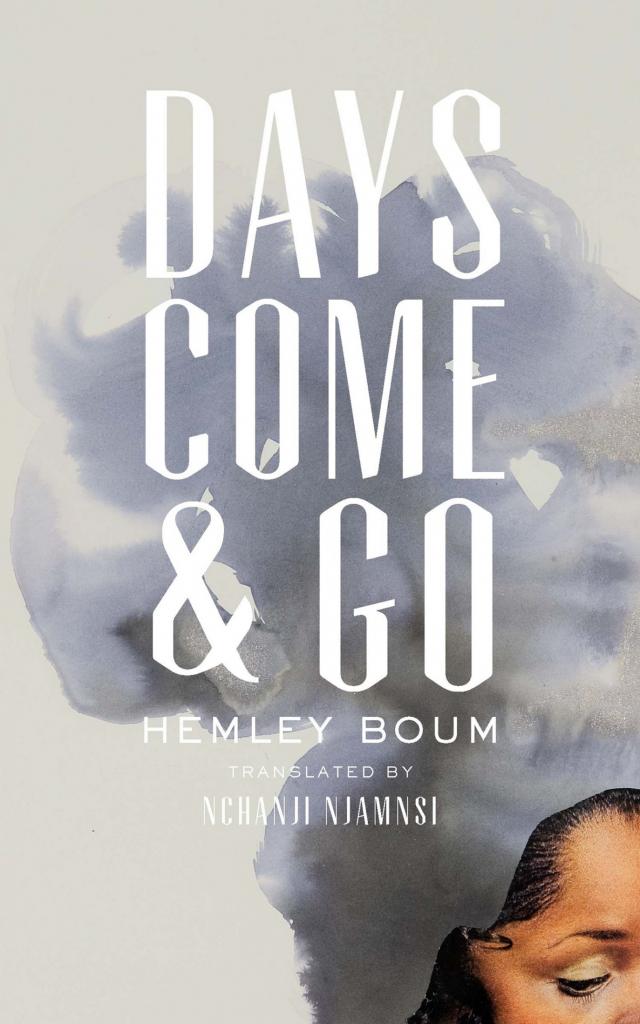


DAYS
COME
& GO
HEMLEY BOUM
Translated from French by
NCHANJI NJAMNSI
Originally published in French as: Les jours viennent et passent
Copyright © 2019 by Hemley Boum
Published by arrangement with Agence littéraire Astier-Pécher
All Rights Reserved
English translation copyright © 2022 by Nchanji Njamnsi
Two Lines Press
582 Market Street, Suite 700, San Francisco, CA 94104
www.twolinespress.com
ISBN: 978-1-949641-35-6
Ebook ISBN: 978-1-949641-36-3
Cover design by Gabriele Wilson
Design/typesetting by Jessica Sevey
Cover art by Lorna Simpson: Up in the air…, 2013
Collage and ink on paper, Unique
29 1/2 x 21 5/8 in (74.9 x 54.9 cm)
Framed: 31 x 24 x 1 5/8 in (78.6 x 61.1 x 4.1 cm)
Copyright © Lorna Simpson
Courtesy of the artist and Hauser & Wirth
Library of Congress Cataloging-in-Publication Data:
Names: Boum, Hemley, 1973– author. | Njamnsi, Nchanji, translator.
Title: Days come and go / Hemley Boum; translated by Nchanji Njamnsi.
Other titles: Jours viennent et passent. English Description: San Francisco, CA: Two Lines Press, [2022] | Originally published as Les jours viennent et passent. | Summary: “Chronicles the beauty and turmoil of a rapidly changing Cameroon through the story of three generations of women” --Provided by publisher. Identifiers: LCCN 2022002132 (print) |
LCCN 2022002133 (ebook) | ISBN 9781949641356 (hardcover) |
ISBN 9781949641363 (ebook). Subjects: LCGFT: Novels. Classification:
LCC PQ3989.3.B686 J6813 2022 (print) | LCC PQ3989.3.B686 (ebook) | DDC 843/.92--dc23/eng/20220131
LC record available at https://lccn.loc.gov/2022002132
LC ebook record available at https://lccn.loc.gov/2022002133
Printed in the United States of America
1 3 5 7 9 10 8 6 4 2
This project is supported in part by an award from the
National Endowment for the Arts.
I
Abi had been driving around the neighborhood for the past fifteen minutes when a car in front of the hospital drove away, freeing up a parking spot. Maybe there’s a god after all, she thought to herself, slotting her car into the spot.
Her mother, Anna, was asleep and snoring noisily. The early morning wash, the few steps down the stairs, the four mouthfuls of yogurt—painfully swallowed—and lastly the half-hour ride in Paris’s mid-morning traffic jam had gotten the best of her. Ordinarily, she enjoyed the ride across the city. She would observe, saying something about all the details Abi now overlooked. The Haussmannian buildings, she’d say, were built at an ideal angle to reflect light, their shadows standing out like cathedrals on the asphalt.
“Stop, we can spare two minutes, right?” she asked.
Although weakened by sickness, she was still adamant. Anna had woken up and spotted a small street flanked by blooming cherries.
“Pull over so we can stroll for a bit, would you?”
Abi obliged without protest. Her mother pulled herself out of the car laboriously and inhaled the cold air. Then she took Abi’s arm by the elbow, always in the same way, and slowly they walked, seeking out the sidewalks lit up by the early spring sun.
Anna greeted passers-by, stopped to chat with garbage collectors, gave change to beggars—quite unlike the average Parisian. When her pace slowed as she ran out of breath, Abi picked a café where they could sit on the terrace. The old lady always ordered the sticky treacle Parisian cafés call hot chocolate. Some days, more frequently now, her pain ruined her appetite, robbing her of the taste of food. She would then content herself with raising the huge mug to her nose and taking long inhales of its aroma.
“This is good,” she said, smiling.
Abi smiled back. She had to submit an article to the culture magazine she worked for, about a performance by a white South African artist portraying Black people in cages and reenacting the human zoos of the early twentieth century. Art morphed into obscene voyeurism, insult and, dressed up like that, was on open display all over the world. She also had to create content for her blog, meet the manager of the nursery about her little Jenny, do some shopping, and think about that evening’s dinner. Her time was precious, fleeting; some mornings, the young woman woke up to the feeling that she was already two hours behind schedule. None of that mattered. Every minute, every hour was pegged to her mother’s hand holding her by the elbow, to the sick old lady’s erratic step, her emaciated features, her short breath… My mother is dying, oh mother…
They had reached the terminal phase of the illness. Abi barely slept. She woke up frightened by the silence if her mother wasn’t making any sound. Or when even the least suspicious sound seeped from the next room. One night, she ended up coming out when she heard her mother in the corridor. Abi switched on the ceiling light and, just in time, held her mother back as she was about to take the stairs.
“Mother, where are you off to?” Anna, blinded by the light, had stopped in her tracks.
“Oh, Abi, did I wake you? I’m sorry, go back to bed. I am going to the bathroom. Everything’s fine.”
No, everything was not fine. Her mother, confused in the darkness, would have fallen down the stairs had Abi not stepped in. She was forced to exercise a calm she did not feel, not even remotely. Her hands trembled and, in her stomach, and down her spine, she felt an unsettling tickle like an electric shock: irrepressible fear, a certainty that things would only grow worse and that there wasn’t much she could do about it. Abi had led her mother to the toilet:
“Wait outside, please. I can still wipe myself, you know.” The old lady had smiled.
Abi hadn’t responded. Her mother could no longer take care of her basic personal hygiene, she who was always such a clean freak. The young woman would return to the bathroom later to clean the floor if necessary. It did not bother her, not anymore.
The first time Anna had unconsciously soiled herself and then the bathroom floor, the shock had rattled Abi so violently that it left her paralyzed. She stared at the feces as if they themselves would realize the strangeness of the situation and disappear out of shame. Then she had scrubbed and mopped the floor, then cleaned her mother. If she didn’t do it, no one else would. That night, Abi had brought her mother back to her own bed.
“You should consider hiring a home care nurse,” the doctor had advised after her last hospitalization. “Your mother wants to stop chemotherapy. Her state will worsen quite rapidly. We can reduce the pain, but not by much. She no longer has the strength to take care of herself.”
She is sick, not deaf. She is still very much in her right mind. She is conscious of what is happening to her. Speak to her like a human being, Abi protested under her breath. She did not want to antagonize the doctor, the nurses, anyone who could ease her mother’s pain. With gritted teeth, she endured their coldness, the raw, technical, definitive words they dished out with professionalism and indifference. The untreated breast cancer had metastasized. It had spread to her pancreas and liver. Chemotherapy would enable her to live six months, a year at most. This time would decrease drastically if she continued refusing treatment. And Anna continued refusing. The aftermath of her first chemotherapy session had convinced her to stop her treatment.
“Well, if the poison they are pumping into my body can’t save me, I would rather stop,” she had objected to an exasperated Abi.
Treat her kindly. I know you see helpless, terminally ill beings every day. I understand the need to keep their suffering at a safe distance, but you must understand: to me, this woman is much more than just a failing body, Abi pleaded silently. She is a loved one, a precious life ebbing away in silence.
Abi did not reach out to any nurses. She was horrified by the mere thought of a stranger touching her mother’s enfeebled body. Some mornings, the old lady examined herself in the mirror. Her hair and eyebrows, now lost. Her muscles, shrunken under flappy skin. She felt like an empty envelope. She even had a glazed look in her eyes now.
“Do you remember how beautiful my hair used to be?” she murmured, caressing her hairless skull.
Yes, Abi could remember. What nurse could boast of such a special skill?
“You’re my mother now,” Anna told her. “I never knew mine; it has taken me getting old and falling sick to taste a mother’s love.”
Yet, the illness spread at such speed that Abi’s sacrifice was rendered useless. The cancer was literally eating away at her mother from within. Abi imagined it as rats gnawing on her liver, stomach, pancreas…stopping only when they’d devoured every single inch of her body. In the beginning, she’d hoped every moment of happiness would keep the old lady alive, the same way one uses all manner of tricks to hold back guests at the end of a dinner. “You can’t leave now. Have some more dessert. Do you care for tea? Come on, take one for the road!”
Walks in Paris, hot chocolate, butter croissants on café terraces, little Jenny’s laughter, visits from her son, Maxime… Indeed, in the beginning, all of this had meaning, but not anymore. Pain clogged the present, permeating every moment of joy. Smiles turned to grimaces.
I do not know how to help you anymore, mother. I do not dare touch you anymore. I’m scared I would hurt you without meaning to. I’m scared I would do something clumsy and make you more uncomfortable while trying to ease your pain. I’m sorry, mother, so sorry. I don’t know how to help you anymore. Abi cried on their way to the palliative care unit.
Her mother sat snoring in the car. The desolation and torment of the past few days had been terrifying; nothing brought her any relief. Initially, Anna had forced herself to maintain an ounce of normalcy, but her weak body no longer obeyed her. Any physical effort exhausted her. Her every gesture grew slow, labored. She stopped getting up from her bed in the morning or feeding herself. The least sip of water triggered groans of pain. “Mother please, just one sip, try again,” Abi kept insisting.
Deep within Abi, a harsher, more urgent voice echoed: I’m not ready. I do not want to lose you now. I’m not ready…
Even deeper within her echoed an awareness of the imminent end and the futility of her prayers.
“Look, mother, it’s spring. The plane trees are green, cherries are in bloom, potted flowers on windowsills are blossoming in the sun, garages are draped with colors, girls are baring their tanned legs. Paris is looking at herself in the mirror of light and smiling back at her reflection, look mother…”
* * *
Palliative care centers offer all the care you cannot find in a hospital. Doctors look you in the eye. Nurses do not hesitate to touch you when they talk to you. A psychologist asks you about your journey so far. They all encourage you to unpack your pain. Here, there is no need to lie to yourself anymore; anyone who comes in here won’t ever leave the same. For both patients and their caregivers, the end of the road is near.
“Tell her family to come see her now,” doctors tell you.
“How much more time do we have?” you enquire amid your mix of worry, hope, and despair.
You want to know the exact date, precise hour—just like any important appointment—not to miss a thing, not to take any risk.
“Tell them to hurry.”
Watch and pray, the Scriptures say. Keep your lamps burning for when the Bridegroom returns.
ANNA
Dying is such a long journey. I have come to the end of my road. My daughter’s anguish hinders me, holds me back. I linger despite the pain and despite my desire to get it over with. I stay because of Abi.
I have always harbored a secret place within. A place where I could retreat no matter what. I call it my stronghold. In this room, because I see it as a room, the walls protect my heart on days of anguish, and happiness is let in as abundant showers of light. It is where I cry out in my pain. It is where I put words to my fears, and also where I sing at the top of my voice. I speak loud. I debate, always brilliantly, finding words that free and unshackle me. I stand at the window when I need to observe the world, then close the shutters when I feel like stepping away from it. This place exists only in my mind, but it’s as real to me as the air I breathe—it’s where I paint the world with my soul’s rainbow. Nobody who has passed through my life, whether family, friend, lover, or husband, has ever entered this room. None except Abi. Barely had she been born when, for the first time, I heard a voice other than my own in this shelter of mine. It was the babble of a child that I recognized right away. I knew then that I was whole at last.
* * *
I never knew my mother. She died bringing me into this world. Just like her mother and her mother’s mother before her. Three generations of girls orphaned at birth. Lives starting amid loss and grief. Abi came along to break the curse.
From the few stories I was told, my great-grandmother was not from our village. She was tall, with a tapered waistline, wide hips, dark skin, delicate features, lush hair. Everyone called her “Samgali”… This uncommon name was the starting point for Abi’s research. She thought that my ancestors may have been Fulani and “Samgali” was the result of a mispronunciation of “Senegalese” in the local language. I laughed at my daughter’s rich imagination but, on thinking about it more, it was not far-fetched.
Islam came to Cameroon through the Sudano-Sahelian route. First came Shuwa Arabs, as early as the seventeenth century, followed by the Fulani or Fulbe in the eighteenth century. The religious conquest only started in the nineteenth century, when Usman Dan Fodio stretched his Upper-Niger empire to the Adamawa and authorized Modibo Adama to create lamidates in Ngaoundere, Garoua, and Maroua. The new conquerors either enticed or forced natives to convert, but were stopped by the immense equatorial forests in the South—to which they were unaccustomed—and by Christianity, which was already deeply entrenched. They settled in the northern part of the country and made it a habit to cross our land during their seasonal livestock drive. Abi explained all this to me. My daughter is a passionate scholar.
Where did Samgali come from? What violence forced her to flee? What strange migration had dropped her off at our doorstep like an offering? If anyone knew the answers, no one ever told me. As contradictory as it seems, our societies are built on both bonds and silence. Our joys are loud and our grief demonstrative. Our voices are strong and our laughter thunderous. But rarely do we say a word about our private lives. We don’t have as many taboos as people claim, but esoteric interpretations blur the messages.
Abi is in tune with her era. My grandson, Max, even more so. They demand answers, all sorts of explanations. They ascribe all sorts of virtue to transparency, which they label truth, and have no patience for pretense. Where do they get this strength from, this confidence that I envy, this arrogance? We are so much more than the sum of our parts. Our gray areas would not stand the light. What world could survive the systematic exposure of everyone’s secrets? This is blasphemy in Abi and Max’s eyes. I understand what they’re saying. I always thought that there were instances where silence buttressed the bond better than baneful truths, but I am not so sure anymore.
* * *
I grew up in the care of Awaya; she was an old village woman, widowed several times over. She had raised my mother before me and had known Samgali. She was our bond: the link between the dead women and their daughters.
Awaya was a tough, hard-working woman. She’d married young to a polygamous man and been bequeathed to his brother; most of her children were grown and had already left home when I was born. Only the two of us lived in her house. She was the first person to tell me about Samgali. They had been married to brothers and shared a great friendship, the kind that sometimes unites two souls that just click instantly.
Samgali died while giving birth. Awaya took in her young daughter, fed the baby her own breast milk, and raised her like her own child until misfortune struck again with even more brutality. One of Awaya’s sons became so madly enamored with Trissia, my grandmother, that he lost his mind. They had been raised by the same woman, in the same house: as far as everyone in our community was concerned, they were siblings. For them to be in love was therefore forbidden, incestuous. But the young man did not listen to reason. He was doomed by his yearning for Trissia. He decided to force destiny’s hand by getting her pregnant. History bears no account of little Trissia, the object of this impure affection. If I reckon correctly, she was no older than twelve then. She died giving birth to my mother. Poor child, a young offshoot torched prematurely, gone up in smoke. The young man fled the village when he learned that his beloved had died. This is how Awaya lost her two children.
My mother’s fate was even worse; she married a man famous for his fits of madness and violence. He beat her furiously one time too many while she was full term.
This is the tragic story of my mothers, the cursed daughters of Samgali.
Awaya took me in just like she had done with those before me, pitting her sense of duty against the cruelty of fate, steadfastly believing in life’s eventual triumph against fatalism. From the day I was born, she called me “Bouissi,” sunrise. Defying the anathema, she decreed that the Stranger’s curse ended with me; we were worthy of the light of a new day. And she made a resolution that would change the course of my existence, but would also pull me away from my family and cause me to betray this woman who had done so much for me, for us. Awaya decided that I would be an educated woman and enrolled me in the mission school.
Every Sunday, my elderly guardian went to church, where she prayed to the Lord fervently. This did not stop her from living out her traditional spirituality with just as much passion, though. When I was born, even before my mother’s funeral, she took me into the forest and marked me for protection. “Enough is enough, Samgali. Enough is enough, my sister. This must stop,” she murmured, cutting my newborn skin with a blade and rubbing a concoction of her own making into the wounds.






