

The broken chord, p.1
The Broken Chord, page 1
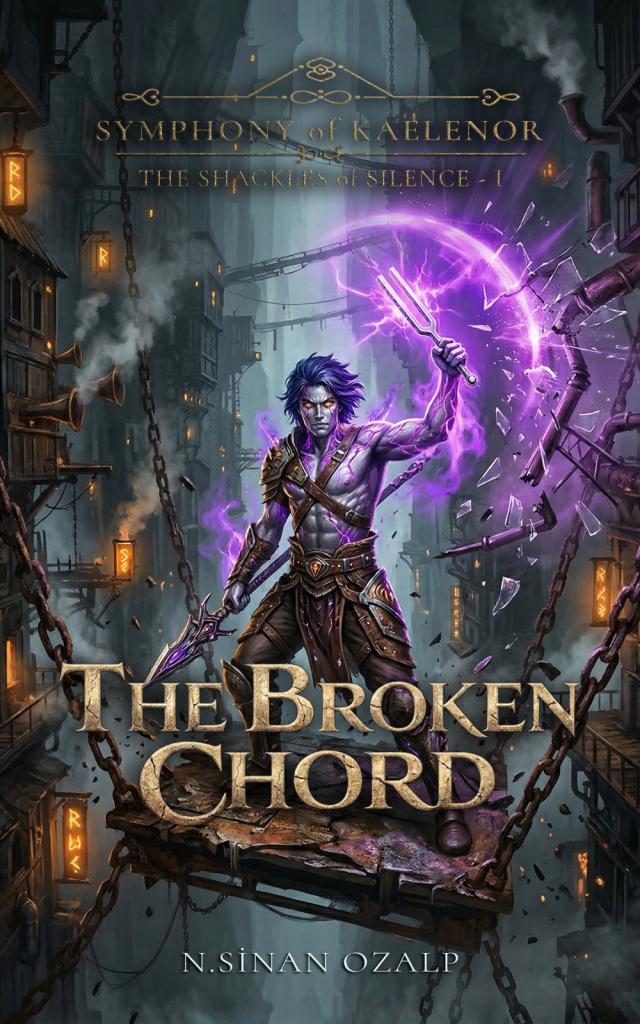


Broken Chord
This is a work of fiction. Similarities to real people, places, or events are entirely coincidental.
THE BROKEN CHORD
First edition. March 26, 2026.
Copyright © 2026 N.Sinan Özalp.
ISBN: 979-8231161096
Written by N.Sinan Özalp.
Table of Contents
Title Page
Copyright Page
Dedication
Epigraph
A Parting Tone
The Dissonance Note
In the Veins of Ironhold
Awakening of the Anvil
Pulse of the Deep-Gutter
The Blind Guide
Rusty Debt
Song Chained to Stone
The Fractured Pass
The Crystal Frontier
Silence Within the Woods
The Father’s Burden
The Glass Horizon
To my wife, the most perfect chord of my life, and to my darling daughter, my purest echo in all the world... For helping me find the music within, even in the heart of silence.
The Iron Bastion: Where Silence Dies and Echo Reigns.
Established within a massive tectonic fissure—The Great Cleft—that cleaves Sky-Piercer Peak right down the middle, this city takes the form of a vertical cylinder, stretching from Kaelenor's highest summit to the deepest roots of the mines. The city's soul lies within the low-frequency chimes of the massive chains tethering buildings to canyon walls, and in that famous 40 Hz Ambient Hum that throbs through every passing second.
In this ancient settlement, sound is more than an emotion; it is an industry forged by runic hammers that tune raw metal, the energy of amber runic lamps lighting the streets, and the cry of colossal Exhaust Trumpets spewing smoke from the canyon walls toward the heavens. In Ironhold, silence is a luxury that only the wealthiest can afford behind walls insulated with gold and lead; for the rest of the populace, silence is the harbinger of an approaching catastrophe.
The city's true character is summarized by these lines from a miner's diary: "In the Iron Bastion, you cannot hear the sound of a stone falling, but you can feel that small 'bass' tremor it creates on the ground through the soles of your feet." The Iron Bastion is a vertical forest of metal and stone, living between the snarl of runic engines and the silent vibrations of the Acoustic Hand Alphabet used by miners to communicate.
THE COLLAPSE OF ORDER
A Parting Tone
Morning never truly came to Ironhold. It only laid another weight upon the night.
When Korian opened his eyes, it was not light he felt first, but that familiar heaviness. The 40-hertz undertone rising from the city’s depths—from inside stone and metal, from the mountain’s roots—had once again settled over every surface of the room. It was less a sound than a pressure fitted onto the body. It struck the inner walls of his skull with slow, relentless blows and seeped into his spine, the roots of his teeth, even the backs of his knees. Somewhere just above the ceiling, high-pressure steam rasped dully, and the blind force rushing through rusted pipes tightened the narrow room’s air one fraction at a time.
He lay still for a while. The metal frame beneath the bed answered the city’s pulse with the faintest vibration. The runic insulation panels on the walls smelled of mildew and old smoke, and the soot gathered in the corners fouled even the weak morning light. In the pale illumination leaking through the window, metal dust drifted heavily, as if the room did not breathe but merely held that immense rhythm inside itself.
When Korian lifted his head from the pillow, as he did every morning, he briefly tested for the other vibration within himself. Something finer, more restless, out of tune with the city’s deep pulse—as though it had been trapped in the wrong place. Just as Elias had taught him, he suppressed it at once. Count your breath. In on four. Keep it short. Let it out silently. He tried to fit his own body into the city’s rhythm without rising above the undertone, without being noticed.
When his bare feet touched the floor, the metal beneath them was not cold but sick—damp, rough, like something that had not seen sunlight in a very long time. A loose rivet shifted slightly under his heel. The dull click it made traced a short circle through the room’s cramped walls. Korian waited. No second sound came. In this house, making too much noise even in the first moments of morning felt like existing more than necessary.
As he stepped into the narrow corridor, the smell of steam, metal, and old oil grew sharper. The walls seemed to press closer together; there was a confinement that narrowed not only his shoulders but his thoughts. Damp had sunk into the wooden frames, and the pipes running beneath the ceiling filled the whole house with a low, ongoing murmur that held everything under a fine strain. When Korian reached the kitchen, he stopped at the threshold without meaning to. He always did. First he listened to the room’s rhythm. Then he added himself to it.
Elias stood at the counter.
His back seemed a little more bent than the day before, and in Ironhold even a little more was not a difference that escaped notice. The weariness settled over his shoulders belonged to more than one night; it was the kind of weight years accumulated, the kind that lodged in the bones if never spoken aloud. As he stirred the old runic pot, each tap of the ladle against the metal rim established the house’s one distinct rhythm. Thud. A brief scrape. Thud. A blue crackle inside the steam. Then once again the city’s undertone, never absent.
When Korian entered, Elias did not turn immediately. He circled the ladle once more along the bottom of the pot, then lowered the flame with one of those small, economical motions of his. Only then did he turn.
Their eyes met.
In this house, many things stood in for speech: how straight a shoulder was held, where a hand came to rest, how quickly a door was opened, how long a gaze remained on a face. Elias’s look was usually brief. Measured. It passed over a person without probing them, merely acknowledging that they were there. Today, though, it lingered on Korian’s face a moment too long. He studied the faint scar near his brow, the line sleep had not yet erased, the way his hair fell by his temple, as if seeing them for the first time.
Something small and dry shifted in Korian’s throat.
Elias said nothing. Words in this house had usually counted not as a need, but as a risk. Yet there was something in that silent gaze far heavier than the morning routine that had never changed in years. Weariness, yes. Concern, as always. But also another layer Korian could not name. His mind found no word for it; only the chill that had settled between his shoulders deepened.
Elias set down the ladle. The metal touched the counter more softly than it needed to. Then he turned to the table. He had already prepared both bowls, but today there was none of the usual rough carelessness. The cracked cloth on the wooden table had been straightened. The bowls had been centered exactly opposite one another. Even the old spoons had been placed not merely side by side, but at the same angle. In this house, care was not a luxury; it was almost a forgotten language. And today Elias seemed to have remembered it for no reason at all.
Steam rose slowly from the spark soup. Bits of metal-root within it crackled now and then with dim blue sparks, while dark oil stains trembled across the surface in tiny rings and merged. When Korian sat down, the seismic pulse passing up through the wood reached as far as his elbows. Elias did not sit opposite him at once. He first adjusted the bowls one more time, then nudged Korian’s spoon slightly inward with the tips of his fingers, as if the boy’s hand ought to have less distance to travel when reaching for it. That, too, was an unnecessary delicacy. Nothing unnecessary was ever done in this house.
When Elias finally sat, even the chair’s sound was kept under control. No scrape. No creak. Only the transfer of weight into wood.
Korian lifted his spoon. The smell of the soup struck his face at once: metal, root, flat salt, a trace of burnt fat. It was familiar—close in the way only something known since childhood could be. But when the first spoonful touched his mouth, it was not the taste that caught his attention, but the way Elias watched him. His father had not yet started eating. He was waiting only for Korian to take the first bite.
Korian lowered his eyes to the bowl. The thin sound of spoon against ceramic seemed louder than it should have. The silence here was no lighter than the noise outside; it was only barer. When he dipped the spoon a second time, Elias began to eat as well. The old order between them held as it always did: the same pace, the same pauses, the same measure. It was less a breakfast than an act of not disturbing the line.
And yet today, everything held exactly on that line while trembling slightly above it.
From time to time Korian tried to lift his gaze and look at Elias without seeming to. His father’s hands were as they always were—large, callused, lined with oil-darkened creases. But today they moved more carefully. Whether he was pushing the bowl, setting down the spoon, or breaking the dry slice of root that served as bread, he did it as if moving around something fragile. Elias’s face retained its usual stony hardness, but the lines around his eyes looked less like the mark of one sleepless night than of a much longer wakefulness.
Korian wanted to speak.
The question came not as words but as a pressure building beneath his throat. Why are you like this? What are you waiting for? What is today? He did not move his tongue. The Active Silence Elias had taught him over so many years was no longer merely a technique; it had become a second frame built into his body. The questions struck that frame and remained inside before they ever reached his lips. They did not disappear. They sank into the city’s undertone and grew heavier there.
For a moment Elias stopped eating. He rested the spoon against the edge of his bowl. Without fully raising his face, he shifted only his eyes to Korian. There was no hardness in that look. Something worse instead: measured attention. The quiet attention of a man trying to carve something into memory for the last time. Then Elias reached out. His fingertips touched the fine line of grime still left beneath Korian’s left cheek. With his thumb he brushed away the metal dust, the soot, a stain too small to matter.
The movement lasted so briefly it might almost have been imagined.
But Korian’s chest constricted at once.
Elias did not immediately draw back his hand. His fingers hovered for a moment near Korian’s jaw. Then they lowered slowly. He turned back to his bowl. The place that small touch had left behind became more distinct than the whole city’s relentless hum.
Without lifting his gaze from the soup, Korian listened to his breathing. It had to remain steady. It had to remain silent. As Elias had taught him, he had to keep the inner vibration buried deep. Yet in the center of his chest another rhythm was tightening, like a hidden chord wanting to turn against the undertone. He did not know why. He only felt that today’s weight was different from every other day’s. As if not the city, but something inside the house had shifted from its place.
When the meal ended, Elias did not at once begin gathering the bowls as he always did. First he remained seated. That was unusual to the point of impossibility. He laced his fingers together on the tabletop and sat there for a brief while doing nothing. The city’s hum passed up through the table, the chair legs, the walls, reaching their bodies from different places. In his father’s stillness, Korian felt the weight of something decided, but not yet spoken.
Then Elias stood.
He took the bowls and carried them to the basin. There was no real sound of running water, only a thin hiss and the low friction of metal beneath it. Even with his back turned, Elias looked tense. His shoulders were not the shoulders of a man awaiting a blow, but of one who had already lodged the blow inside himself. Korian remained in his chair. His hand moved involuntarily to the edge of the table. He felt the vibration beneath the wood at his fingertips. When he was a child he had thought it a game; then Elias had taught him how to tell which was the city’s pulse and which was his own. Today the two seemed to be drawing dangerously close.
When Elias turned back, he held Korian’s cloak.
Normally it hung by the door, taken up in a single motion on the way out. Now Elias had brought it over in both hands. Korian rose. As his father set the cloak across his shoulders, he did not merely drape it there; he straightened both sides carefully, smoothed the crease gathered at the nape, pressed the seam at the shoulder flat with his fingers. Then his hands remained on Korian’s shoulders.
They were heavy. Not as heavy as usual. Heavier.
Korian lifted his head.
This time Elias did not avert his gaze. And in it there was nothing familiar like be careful or be quiet, but something far deeper and far more helpless. His lips did not move. Even if they had, there was no room in this house for large words. But the weight of his hands passed through the silence like a single sentence: hold yourself together.
Korian did not understand why he thought that. He only felt an unnamed fear knot itself at the back of his throat.
Elias withdrew his hands and turned toward the door. As he reached for the runic locks above the heavy metal frame, he moved more slowly than usual by a fraction. His fingers found the proper sequence from old habit, yet there was still a brief pause—so small it was almost imperceptible—before he touched the bolt. Korian watched him from behind. That broad back, that body steeped in the smell of rust and oil, ought to have looked like a shield, as it did every morning. It did not. For the first time it seemed as though what he carried was not merely a workday.
Elias turned his head slightly. He did not look fully back, only glanced at Korian again from the edge of his vision. There was nothing left in this morning now that did not resemble a farewell. But Korian still could not name it that. He knew only that even before the door opened, the fragile silence inside the house was on the verge of cracking.
The city was waiting outside.
And today, it seemed somehow nearer.
The fragile order inside the house shattered the moment the door opened.
It had never been truly silent within. The muffled rasp of the pipes, the low vibrations moving through the walls, the seismic pulse beneath the table had always been there. But the instant the bolts were drawn and the door gave way, all of it vanished. Ironhold closed over them with its true voice.
The hum rising from the canyon struck not only the ears, but the ribcage itself. The rhythmic thrust of colossal pistons, the unbroken grind of runic gears turning in the upper tiers, the harsh groans pouring from the metal throats of cargo cranes, the dry multiplication of thousands of footsteps climbing from the lower levels and ringing against iron... together they formed not merely a cacophony, but something like a single will. The city did not speak. It imposed.
They paused for a moment on the threshold.
The air that hit their faces was not cold, but rusted. Ozone, steam, old oil, wet stone, coal soot, and the bitter taste of heated metal that clung to the throat. The canyon’s yawning void before them stained even the morning light. Above, along the fissure that seemed to rise all the way to the sky, hanging bridges, chained cargo platforms, pipeworks, and runic transmission spines tangled into darkness, until any sense of depth gave way to a feeling of constant descent. The city did not merely surround a person. It pulled them downward and upward at once.
Elias looked out first. Then, with a movement so small it was almost invisible, he touched Korian’s shoulder.
Forward.
When Korian crossed the threshold, the last buffer of the house sealed itself behind him. In that moment he understood that what they had left inside was not a refuge, only a thin membrane that delayed the direct weight of the outside by a few hours. In Ironhold, even walls did not protect you. They merely changed the form of the pressure.
They stepped into the narrow passage. The metal grates beneath their feet gave a faint rattle from the vibrations of the pipes and support lines running below. To the right, the blackened doors of workers’ dwellings carved into the canyon wall stood in a row, with people already spilling out from some of the thresholds. Bodies in gray overalls. Women whose faces remained half in shadow. Miners with tool belts slung over their shoulders. Children not yet fully rid of sleep. No one seemed truly hurried, yet all of them moved as though bowing to the same invisible force. Their steps differed. The rhythm was one.
As always, Elias placed Korian on his left, nearer the canyon wall. That side was narrower, darker, less exposed. Korian took his place without thinking. Walking beside Elias had never simply meant walking. His pace, his direction, the set of his shoulders, even how much breath he was allowed to take, all remained inside boundaries chosen by his father.
Crossing the first bridge, Korian saw the difference.
The number of guards.
Every morning there were Iron-Bound stationed at certain points—junctions, elevator hubs, factory entrances. But today, where there should have been three, there were five. Their brass breastplates threw back dull, cold smears of the canyon’s filthy light, and their hydraulic joints gave off short, perfect beats with every step. Their faces remained hidden behind metal masks as always, but today they stood stiller, looked more directly. The bodies of workers passing them tightened without knowing it. Shoulders folded inward. Eyes dropped. Lips that might have opened to speak thought better of it before they parted.
At the end of the bridge, two acoustic scanners had been set up in the narrow corridor where normally only cargo records were checked. Their thin, arched metal necks reached into the crowd, probing the air with a low, needling whine. It was the kind of sound felt less in the ear than in the roots of the teeth. The moment Korian sensed it, his jaw clenched on its own.






